You Don't Have a Prompting Problem. You Have a Context Problem.
Build Your AI OS — a course that fixes the thing underneath the frustration

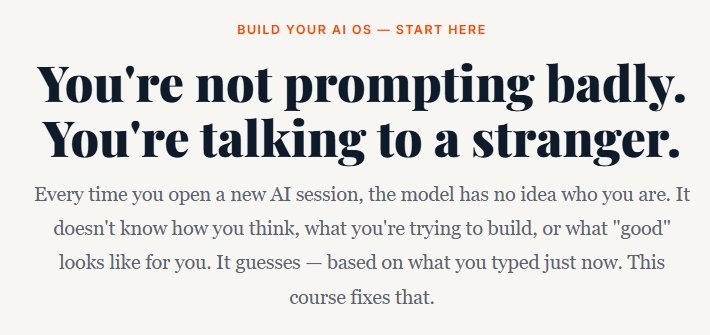
If you’ve been reading The ECHO Files for a while, you’ve probably seen me talk about ECHO — the full AI operating system I build for people whose work depends on AI actually knowing them.
A lot of you have responded with something like: “This sounds incredible but also like... a lot. I’m not sure I’m there yet.”
Fair. And honestly, that response is what built this course.
Because here’s what I kept noticing: the friction people are feeling with AI right now isn’t a skill gap. It’s not a prompting gap. It’s a setup gap. Nobody ever showed them there was a setup to do.
The Oil Change Problem
I was talking to someone recently who was furious that her five-year-old VW was in the shop. Engine trouble. Expensive. And when I asked what happened, it turned out she’d never changed the oil. Not once in five years.
It’s in the manual. She just never had a reason to open it, because nobody ever told her there was a manual worth opening.
(For the record: I did judge her a little. It’s in the manual.)
A lot of people using AI right now are in the same situation.
They’re using their tools daily. Getting value. But also re-explaining themselves every single session, getting responses that feel just slightly off, wondering why it always agrees with them even when they’re wrong, losing context every time they close the tab.
And they assume this is just how AI is. That the ceiling is the model. That they need better prompts.
They don’t. They just need to change the oil. The manual exists. Nobody handed it to them.
So I built one.
What the Course Actually Is
Build Your AI OS is a 7-unit course that walks you through building a personal AI operating system from scratch — a lightweight set of documents that install into any AI tool and give it a working model of who you are, how you operate, and what “good” looks like for you specifically.
It’s not a video course. It’s a reading course with exercises and real artifacts you build as you go. Most people spend 5–10 hours total depending on how deep they go. You can read a unit in 15–20 minutes; building the artifact takes another 15–30. By Unit 6, you have something real and installed.
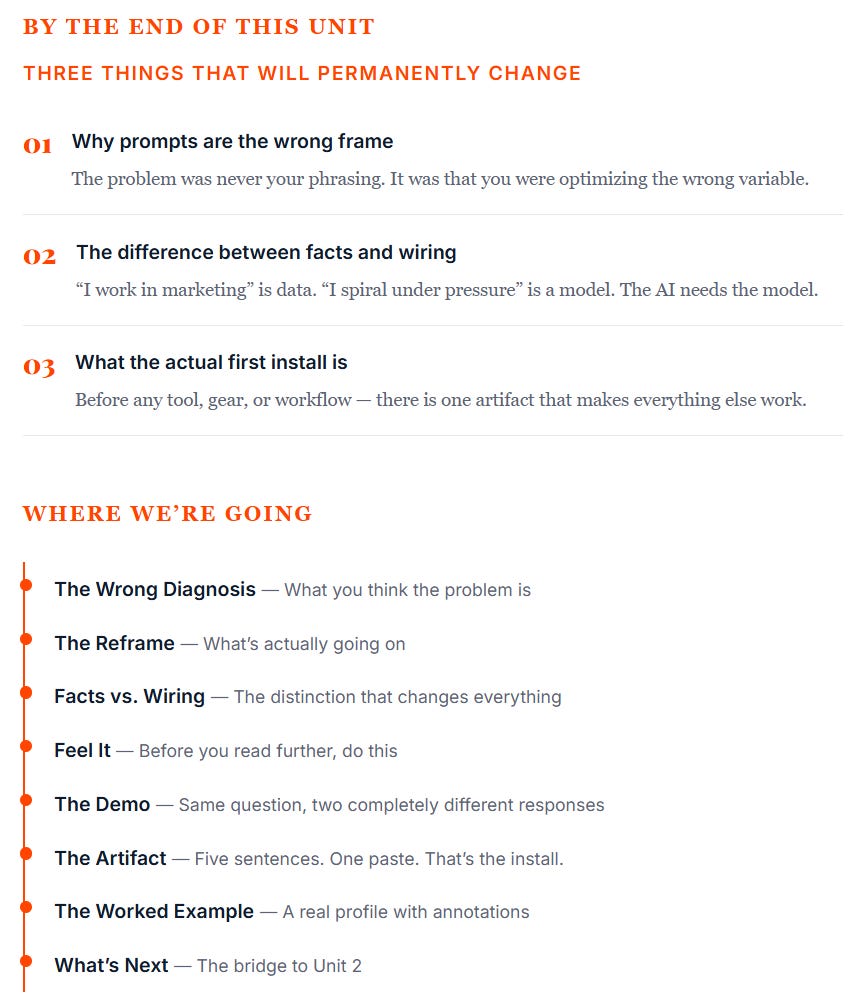
Unit 1 — The Self-Profile. Five sentences. How you actually process information, what your failure mode is, what you need from AI to do your best work. Not preferences — wiring. The AI reads this before everything else.
Unit 2 — The Operator Profile. The things that would take a new colleague weeks to figure out about you, compressed into a paragraph. The distinction this unit teaches — between facts (”I work in marketing”) and structural features (”I make worse decisions in real-time than in writing”) — is probably the most useful thing in the whole course.
Unit 3 — The Behavioral Contract. Your AI validates everything you say — not because it’s bad AI, but because agreement is literally what it’s trained to do. This unit teaches you how to build three constraints that give it explicit permission to push back, stay direct, and catch you making your characteristic mistake. Not preferences. Constraints. There’s a difference, and it matters.
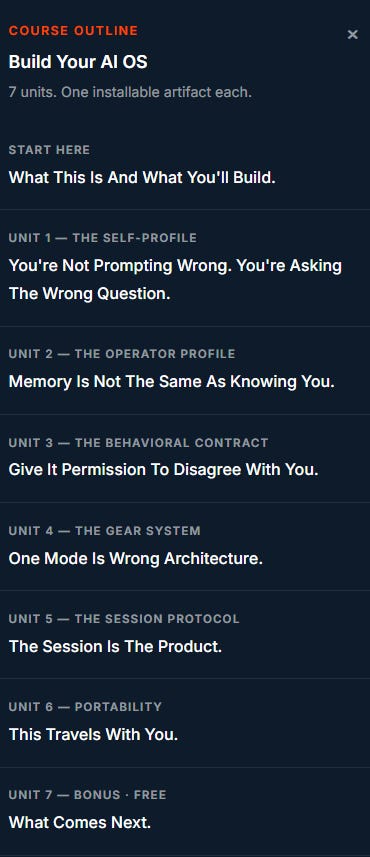
Unit 4 — The Gear System. One AI in one mode is wrong architecture. Your AI is averaging across every possible posture simultaneously. Gears are named trigger phrases that shift its posture on demand. You leave with Interview Mode, Handoff Mode, and a framework for building whatever your work actually requires.
Unit 5 — The Session Protocol. Every session starts cold because there’s no mechanism to carry context forward. This unit introduces a 2-minute opening ritual and a 2-minute closing ritual. The closing produces a state document. The next session opens from it. Sessions compound instead of restart.
Unit 6 — Portability. The system you built lives in a text file, not in Claude’s memory or any platform’s settings. This unit makes that explicit — and shows you what to do when your company switches tools, a new model ships, or you start a new job. The wiring is yours. The model is a socket.
Unit 7 — What Comes Next (Free Bonus). The honest debrief. What you built, what will still frustrate you, and a 7-day commitment to lock the ritual in before it becomes a technique you used to do.
What You Actually Walk Away With
Unit 6 closes with a modal that brings everything together — a fully populated ECHO example showing what a complete, running AI OS looks like, and your blank template to fill in with everything you built across Units 1–5.
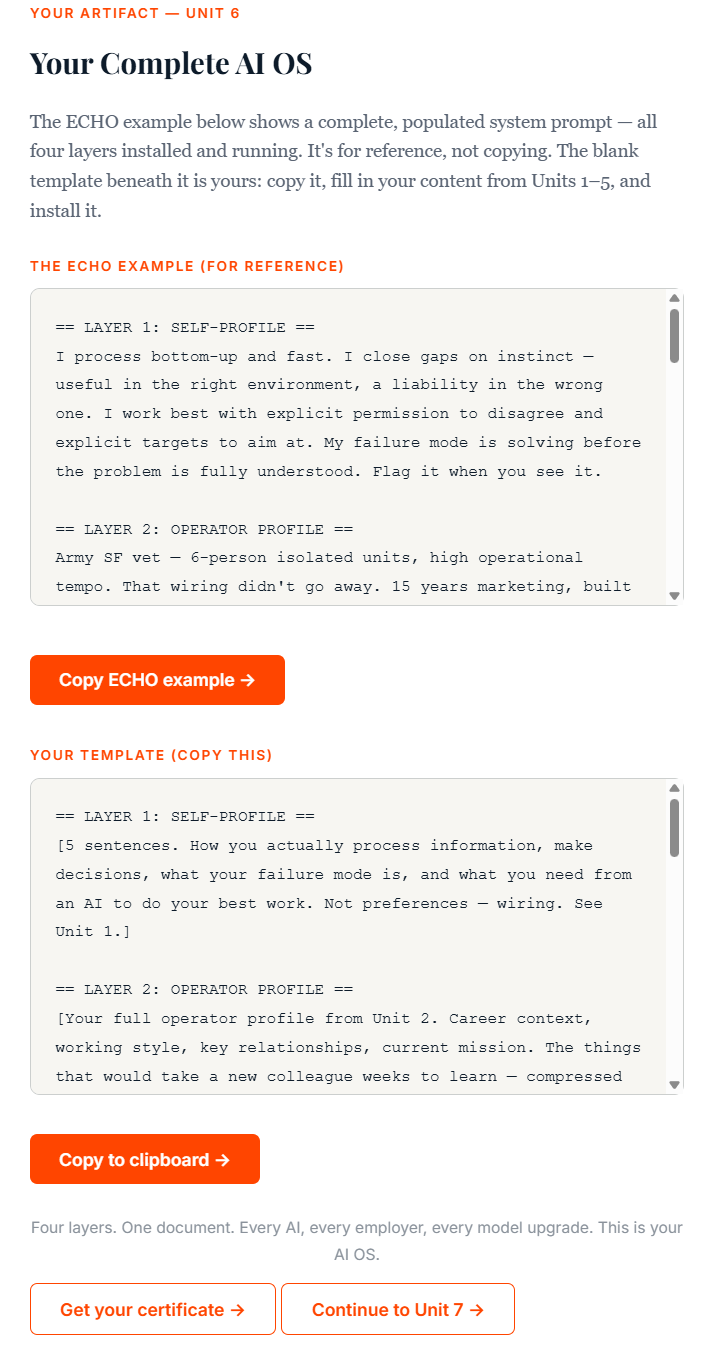
Four layers. One document. Every AI, every employer, every model upgrade. That’s your AI OS.
There’s also a completion certificate. It says: “This certificate was generated by an AI. The work that earned it was done by a human.” Felt right.
One Good Setup
Most people are one good setup away from AI that actually works for them. Not a better model. Not a smarter prompt. Just a system that tells the AI who it’s talking to before the conversation starts.
This course is that setup. It takes a few hours. It installs in minutes. And unlike anything platform-specific, it travels with you — to the next tool, the next job, the next model version.
That’s all it is. That’s all it needs to be.

Pay what you want. Suggested: $24.99. Free is fine too.
7 units · 5–10 hours · one working system.
The context vs. prompting distinction reminds me of the old database design principle: garbage in, garbage out. But there's an interesting parallel in how consumer AI products are solving this — companies like Notion and Linear are essentially building context layers that make their AI features dramatically more useful without users thinking about prompts at all. The winners seem to be those who hide the complexity while maximizing the context.