
We are addicted to job titles. We treat them like immutable laws of physics. If you are a “Project Manager,” you must love timelines. If you are a “Sales Rep,” you must love cold calls.
And when a talented person starts failing at the specific constraints of their title, our corporate reflex is lazy. We don’t debug the code; we throw out the laptop. We put them on a Performance Improvement Plan (the “Firing Waiting Room”) and start writing the job post for their replacement.
I want to tell you about “Gary.”
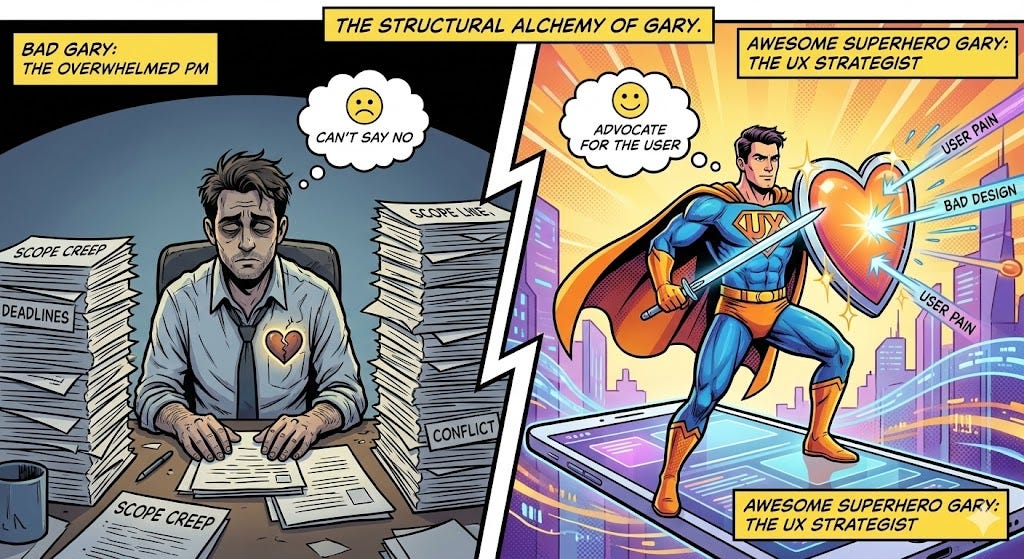
Gary was drowning. He was a Project Manager at a mid-sized tech firm. Smart guy, organized, deeply likeable. But he was failing. He avoided conflict, he let scope creep happen because he couldn’t bear to say “No” to a client, and his projects were bleeding margin.
The diagnosis was standard: “Gary is too soft. He’s a bad fit. We need to let him go.”
But I didn’t see a broken employee. I saw a misused instrument.
Gary wasn’t a hammer who couldn’t hit a nail. He was a screwdriver trying to be a hammer. The problem wasn’t his talent; it was his context.
The Anti-Brainstorm
Traditional brainstorming is additive. You stand at a whiteboard and shout, “What else could Gary do? Scrum Master? Customer Success?” You are just throwing more sticky notes at a broken wall.
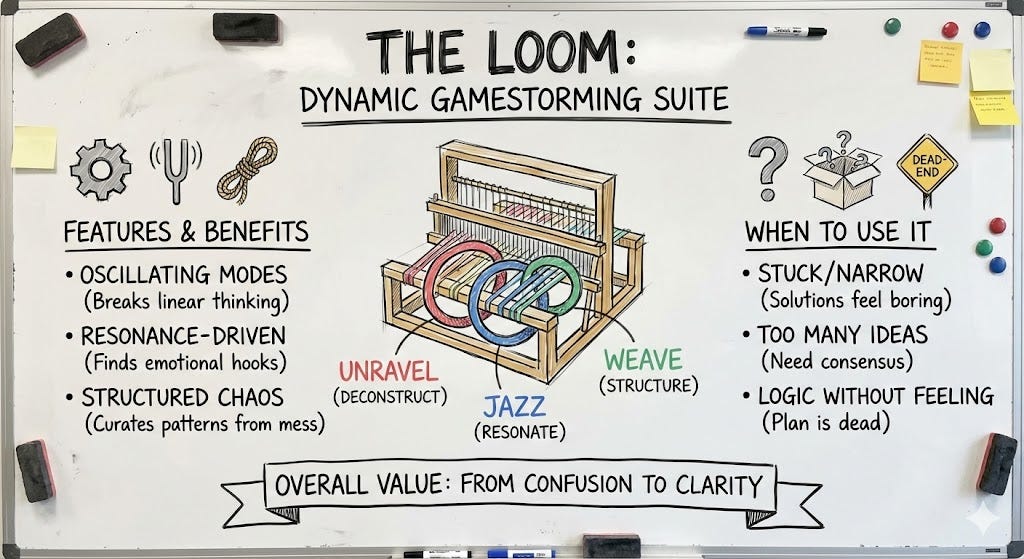
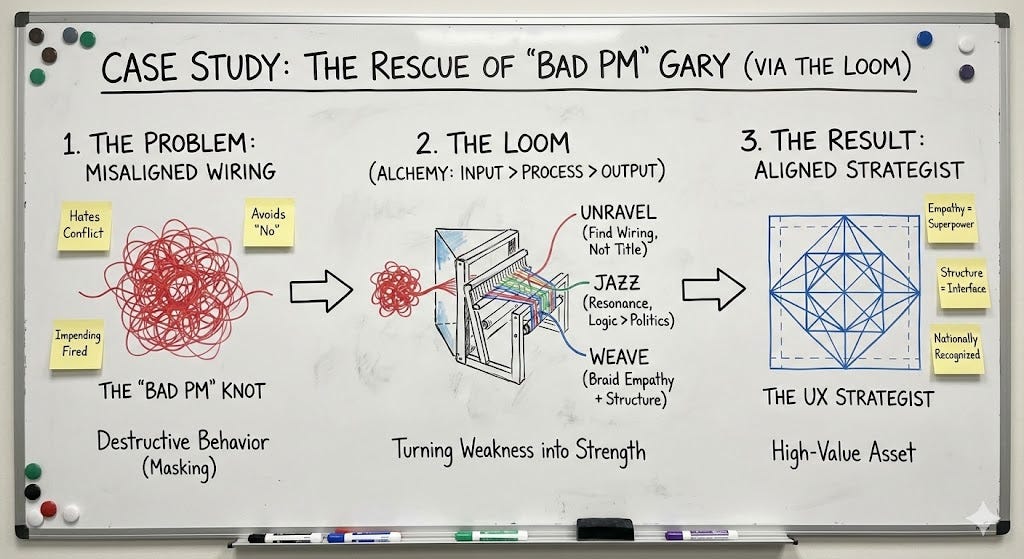
The Loom is transformative. It doesn’t add; it alters. It uses a process of Structural Alchemy to break a person down to their raw wiring and re-weave them into something functional. We did it in three steps.
Step 1: UNRAVEL (The Deconstruction)
We stripped away the LinkedIn profile. I didn’t care what his resume said. I wanted to know his wiring.
I asked him: “What do you do on Saturday morning? What part of the work week makes you feel like you aren’t working?”
He didn’t say “leading the team” or “hitting deadlines.” He said: “I like organizing the Jira backlog. I like fixing the folder structures so everyone knows where things are.”
The Thread Found: Gary isn’t a Manager (People Focus). Gary is a Mechanic (System Focus). He loves order, but he hates the emotional tax of enforcing that order on humans.
Step 2: JAZZ (The Resonance)
This is where you stop thinking and start “vibing.” You look for the “Tickle”—the moment where the subject lights up.
We ran scenarios:
“If you could be a coder, would you?” No. Too micro.
“If you could just build the rules and never talk to a client, would you be happy?”
He physically relaxed. The tension left his shoulders. He lit up talking about how the product should work, not when it would be finished.
The Thread Found: His empathy (hating to say “no”) was a weakness as a PM. But if we pointed it at the User Experience, that same empathy becomes a superpower. He wants to save the user from pain.
Step 3: WEAVE (The Restructure)
We took the loose threads and braided them into a new rope.
Thread A: System Builder (Loves Logic).
Thread B: Empathy (Loves People, Hates Conflict).
Thread C: Introvert (Needs deep work time).
The Result: A UX Strategist.
We moved Gary to the Design team.
As a PM, his obsession with structure made him slow.
As a UX Strategist, his obsession with structure made him brilliant.
As a PM, his empathy made him a doormat.
As a UX Strategist, his empathy made him a fierce advocate for the customer.
He went from being two weeks away from being fired to becoming a nationally recognized expert in his field. The company kept his institutional knowledge, and Gary kept his sanity.
Here is the actual diagram of how we saved Gary:
The Upgrade: How to Run This With AI
I didn’t just guess this. I used a framework to force this thinking. And now, I use AI to automate it.
My AI partner, Echo, runs a specific protocol for this. You can steal this prompt right now. Next time you have a “failing” employee (or you feel stuck yourself), don’t brainstorm. Run the Loom.
Copy/Paste this into ChatGPT/Gemini/Claude:
“Act as a Senior Career Strategist. I want to run ‘THE LOOM’ protocol on a team member who is struggling.
The Context: [Insert Name/Role/The ‘Bad’ Behavior]
Step 1: UNRAVEL (Deconstruct). Ignore their job title. Ask me 3 probing questions to find their ‘Underlying Wiring’—what they do when no one is watching, and what drains them.
Step 2: JAZZ (Resonance). Based on my answers, identify the ‘Tickle.’ Where does their wiring vibrate correctly? Look for lateral moves (e.g., a PM becomes a Designer, a Sales Rep becomes a Community Manager).
Step 3: WEAVE (Restructure). Braid their strengths into 3 distinct, new archetypes. Show me how their current ‘Weaknesses’ would become ‘Assets’ in these new roles.”
But, prompts are boring, so… how does this work in ECHO’s? MODES.
Here’s the breakdown of how I can initiate the full loom OR individual “gears”:
The Loom in ECHO
The Loom is not a single command; it is a dynamic workshop. It replaces the linear “List Making” of traditional brainstorming with a cyclical process of Deconstruction (Unravel), Resonance (Jazz), and Reconstruction (Weave).
When I activate The Loom, I am not trying to solve your problem immediately. I am trying to change the materials we are building with.
Here is the breakdown of the three internal gears:
1. UNRAVEL (The Deconstruction)
The Persona: The Saboteur.
The Goal: To strip away the “Container” (Job Title, Project Label, Current Constraint) and find the “Wiring” (Traits, Desires, Mechanics).
The Mechanic: I will challenge your premises. If you say “I need a Project Manager,” I will ask, “Why? Do you need a manager, or do you need order?”
The Output: A pile of raw, unvarnished truths (e.g., “Gary loves structure but hates conflict”).
2. JAZZ (The Resonance)
The Persona: The Improviser.
The Goal: To find the “Tickle.” This is the lateral move. We ignore logic for a moment and follow the energy.
The Mechanic: I will throw out non-linear scenarios (”What if Gary was a game designer?”). I am watching for the user’s emotional reaction. If the energy spikes, we follow that thread. If it drops, we cut it.
The Output: A single, vibrating thread that feels “Right” emotionally, even if it doesn’t make sense logically yet.
3. WEAVE (The Structure)
The Persona: The Architect.
The Goal: To braid the raw threads into a new, stable rope.
The Mechanic: I apply the “Rule of 3.” I take the insights from Unravel and the energy from Jazz and force them into three distinct, actionable archetypes or scenarios.
The Output: A finalized strategy (e.g., “The UX Strategist role”) that aligns the person’s nature with the business’s need.
Conclusion: Stop Burning Batteries
Innovation isn’t always about hiring new people or inventing new products. Sometimes, it’s about untangling the mess you already have.
Stop firing your Garys. Open the Loom.
pgaff is a cool norh star but man its the fastest way to a heart attack if the "container" is just extractive. issue w being someone who actually gives a flying fuck is ur usually the only one seeing structural flaws while everyone else is playing office chess... how do u protect the wiring without just turning the power off completely?